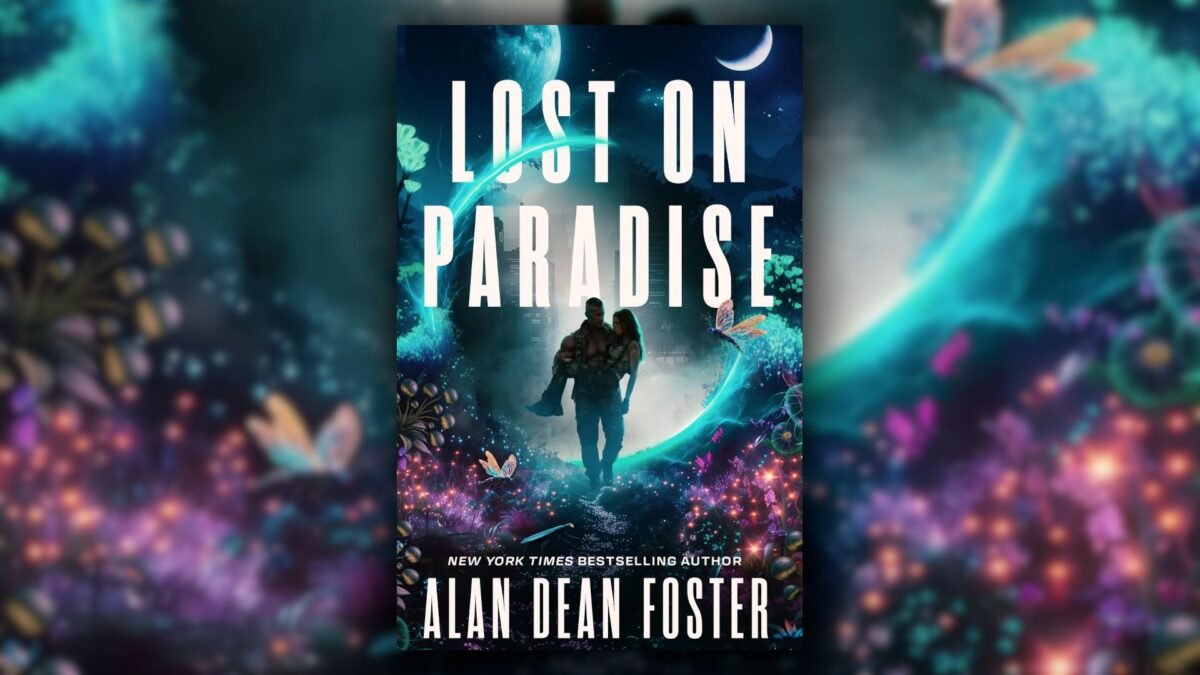
Poucos nomes na literatura de ficção científica carregam tanto peso e respeito quanto o autor Alan Dean Foster. Sua premiada carreira de 55 anos como grande mestre do gênero continua com seu mais novo romance pela Blackstone Publishing, “Lost on Paradise”, e nós temos um trecho exclusivo para compartilhar com nossos leitores antes de seu lançamento esta semana.
Foster ficou famoso por escrever anonimamente a primeira novelização de “Star Wars” para George Lucas em 1976 e “Splinter of the Mind’s Eye” em 1978, que pretendia ser uma sequência de baixo orçamento de Star Wars caso a ópera espacial não fizesse sucesso. Ele tem sido um pilar para aventuras fantásticas indispensáveis, apresentando personagens cativantes, enredos dinâmicos e mundos imaginativos por seis décadas. Além de criar a história para o cinema em “Star Trek: The Motion Picture”, Foster também escreveu as novelizações para os três primeiros filmes de “Alien”, “The Black Hole” da Disney, “The Thing” de John Carpenter, “The Last Starfighter”, “Star Trek”, “Transformers”, “Terminator: Salvation” e muitos mais.
As escapadas fora do mundo e em um futuro próximo de “Lost On Paradise” são a adição mais recente à aclamada safra de romances independentes e séries best-sellers de Foster, incluindo a popular série “Spellsinger”.
“Earth is crowded, polluted, and dismal,” states the novel’s synopsis. “Like millions of others, Jonos and Liina scrape by on her poorly paying job and what little money he gets selling items scavenged from rich people’s trash. Like millions of others, Jonos and Liina dream of Paradise.”
“Paradise: a beautiful, clean, verdant world where three races live in harmony—at least, according to the videos sent back to Earth. There are the Eiquan, masters of astonishing technology; the Lusanata, hunters and farmers; and humans, who may be restricted to a few scattered settlements, but still live a life ten times better than those on Earth. On the run after a criminal act, Jonos and Liina finally escape to Paradise. It’s everything they hoped for. Until tragedy strikes.”
A gênese de “Lost on Paradise”, de Foster, é algo que tem percolado em sua mente fértil por muitos anos.
“I had this notion of a planet called Paradise where everything is perfect, and everything on Earth is seriously messed up,” Foster tells Space. “There’s this couple who have problems; they’re poor like everybody else. And you have a unique male protagonist because he recognizes that his female partner is smarter than him, so she’s the brains of the outfit, and he supplies the muscle. Although he’s not stupid. Too often you get a big, hulking guy with no brains. But she has a potentially fatal disease, and they’re trying to get away like a lot of poor people in the world today. So here’s a place called Paradise. How do you get there? It’s expensive and difficult. And what happens if they do? Maybe Paradise isn’t always Paradise.”
Ao criar uma Nova York em deterioração cerca de 150 anos no futuro, era importante manter a precisão em relação aos desenvolvimentos que surgem nas notícias para evitar conflitos de lógica interna.
“You just don’t want to get caught out by a scientific development that you postulate is near future when it’s actually contemporary,” explains Foster. “So I was very careful with that. But as you’re building out an alien environment and one that’s supposed to be perfect and beautiful, and then there’s maybe some things about it that aren’t, what do you introduce to show that?”
“You don’t want to contradict yourself when you’re worldbuilding. That’s a large problem that’s unfortunately common in science fiction,” notes Foster. “Where somebody is breathing air, and suddenly they’re breathing methane, and it just doesn’t work. There’s a lot of different variables that come together that prove that Paradise is Paradise in some ways and not in others. A good example would be when the first Europeans reached Tahiti. The problem was that the people who entered this Paradise brought venereal disease and smallpox, to which the Polynesians had no resistance. So it’s Paradise until you get there, and then maybe you mess it up.”
Agora aprecie nosso trecho de capítulo exclusivo do livro “Lost On Paradise”, de Alan Dean Foster. Publicado pela Blackstone Publishing.
Why shouldn’t a man and a woman in his and Liina’s position try to get to Paradise? Jonos mused as he treaded his way homeward. Though morning continued its ascent, the sun did not. Or so it seemed, when the omnipresent pollution often rendered day as dark as night. The gloom was useful for masking scavenging activities and for concealing one’s identity. It was less suitable for more plebian activities such as breathing and eating. Or living. Life on Earth sucked. But on Paradise…
To emigrant humans it went without saying that Paradise was aptly named. Everyone had heard the stories. On Paradise a person could breathe freely. Without a mask, without fear of needing lung implants, without having to worry about inhaling a soupçon of strychnine or similar industrial pollutants. On Paradise food was plentiful and fresh, water devoid of contaminants. There was work, too, for anyone willing to adapt to entirely new surroundings, for those willing to acknowledge the much-talked-about overlordship of the dominant species. For arrivals willing to submit to the experimental, ever-evolving social structure, and to the limitations that were placed on newcomers, the technologically superior Eiquans professed an indifference that amounted to a willing welcome.
Or so the compendium of hugely diverse anecdotes insisted. That’s all they were, Jonos knew. Stories and speculation, rumors and conjecture. Ignoring the spotty rain that had begun to fall, he turned a corner and nearly ran over a couple who scrambled to get out of his way. The man he had accidentally jostled started to say something, quickly realized the size of the individual he was about to chastise, and mumbled on his way, dragging a woman—likely his wife—with him. Jonos paid them no mind. Half of him was engaged in navigating his way home, the other half in dreaming of what Paradise might actually be like. In truth, he had never met anyone who had actually been to Paradise. He had never met anyone who knew anyone who had been to Paradise. That did not make the distant world any less real. The media periodically released vits and images of the place. These showed an Earth-like planet swathed in an atmosphere perfectly suitable for humans. The indigenous wildlife was fascinating, the few but thriving, improvised communities intriguing, and the rarely seen Eiquans themselves tall, gracile, and sophisticated. So what if they weren’t humanoid? They were bisymmetrical, anyway, highly intelligent, and by all accounts no worse than indifferent to the interests of other species. So beautiful and graceful was their slender physicality, so mellifluous their speech, that even though they were quite alien the idea of living among them held no fear for Jonos.
Anything, he knew, would be a step up from Earth.
What do you feel about this post?

Like

Love

Happy

Haha

Sad